Most AI ad creative is going to make the feed more crowded, not better.
Give everybody the same tools, the same swipe files, the same "write me 20 hooks" prompt, and you get the same ad wearing 20 different shirts.
That is already happening. Everybody has a short vertical video. Everybody has a creator saying "I wish I knew about this sooner." Everybody has the first two seconds engineered within an inch of its life.
Some of that works. I am not pretending vertical creator ads are dead. We run them. They can print.
But when every brand is chasing the same format, the format starts becoming invisible. That is where I keep coming back to marketing fundamentals.
The job is still the same: get attention, build trust, make the offer clear, and send the person somewhere that makes sense.
AI can help with speed, research, cuts, variants, reporting, and the annoying production work. It cannot replace the part where a human looks at the feed and says, "why are we doing what everybody else is doing?"
Format is strategy
Most teams treat format like an export setting.
Square. Vertical. Landscape. Static. Video. Done.
That is too shallow. Format changes how the ad is received.
A 9:16 creator video on Reels feels like a person talking into the feed. A 16:9 YouTube-style video can feel more like a real breakdown, demo, or story. A YouTube in-feed ad is basically thumbnail competition. A Discover image ad is competing with editorial content. A Meta partnership ad feels different because the creator identity is attached to the ad.
Same offer. Same product. Different job.
At AppSumo, this shows up all the time. For a dedicated deal promotion, we might have UGC, creator videos, founder videos, product demos, static deal cards, comparison-style images, native Demand Gen images, and YouTube cuts all pushing the same product.
This is the kind of mix I mean. Same general channel, completely different ad experience depending on the format and placement.
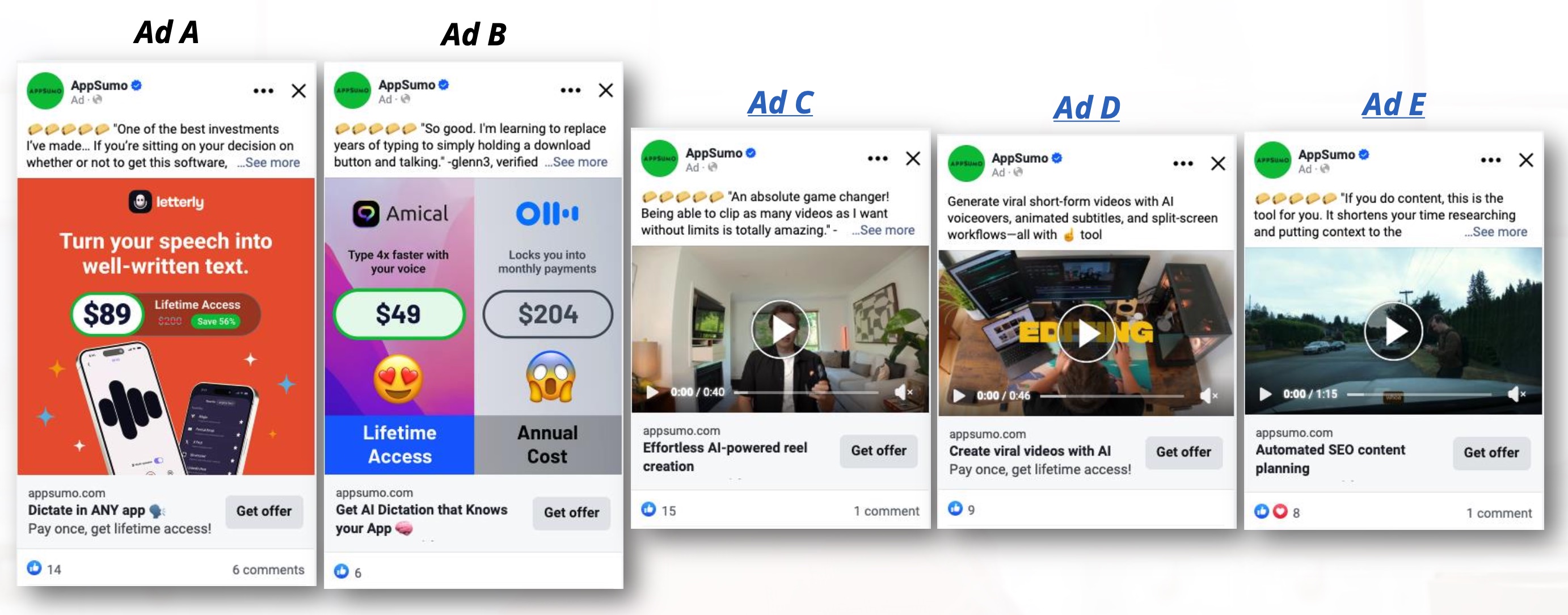
The lazy version is to ask AI for more hooks.
The better version is to ask what the format is supposed to do.
Is this ad supposed to stop someone cold in a social feed? Is it supposed to feel like a recommendation from a creator they already watch? Is it supposed to look native inside YouTube search or in-feed? Is it supposed to make a complicated product feel simple in 10 seconds? Is it supposed to give someone enough context that they actually click with intent?
That is where the test gets interesting.
If everyone is doing one thing, test the boring other direction
One of the most useful creative tests right now is almost embarrassingly simple.
If everybody in your category is running short vertical snap-hook videos, test 16:9. Longer. More context. More story. Less manic.
We have been testing this in real accounts because the feed is full of the same style of ad. Fast cut, huge caption, creator holding the product, aggressive opening line.
Again, that format can work. But if the entire auction is full of it, doing the opposite becomes a real test, not a creative preference.
A 16:9 video can make the ad feel less like a recycled TikTok and more like a useful explanation. That matters for products where the buyer needs to understand the thing before they click. Software, higher consideration ecommerce, AI tools, products with a real before-and-after, anything where "watch me explain this for 40 seconds" might be more believable than "this changed my life in 3 seconds."
I like tests like this because they come from common sense.
If the feed is noisy, do something quieter. If everybody is yelling, talk like a person. If every ad is cropped vertical, test a wider frame. If every creator is doing the same hook, let one tell the actual story.
This is the kind of thing AI will not naturally give you if you let it average the internet. It will look at what is common and help you make more of it.
That is useful for production.
Terrible for taste.
Think about the device too
There is another layer here that sounds obvious once you say it out loud.
Where is your customer actually spending time?
Not "Meta." Not "YouTube." Not "social." The real place.
Facebook.com on desktop. Instagram Stories on mobile. YouTube pre-roll on a TV. YouTube Shorts on a phone. Google Search on a laptop during work. Gmail in a browser. Reddit at midnight. Whatever is true for your customer.
One of the best ideas from Dale Carnegie's How to Win Friends and Influence People is to "try honestly to see things from the other person's point of view". That is usually treated like a relationship principle, but it is also one of the most useful marketing rules ever written.
Put yourself in the buyer's day.
I was talking through this recently for an ecommerce account where the ICP skews older, more male, and much more Facebook-heavy than the average DTC brand. The post-purchase survey made it pretty obvious. A lot of customers said they first heard about the company through Facebook. Actual Facebook. Not Instagram with a Meta label slapped on top.
But when you open Ads Manager, it is easy to stop thinking that way. You say "Meta," let the system run, and move on. Then later you realize spend has been drifting into Instagram placements that may be less aligned with how the customer actually shops.
Yes, the algorithm is supposed to optimize. Cool. I like algorithms too.
But the only way to know where the money is actually going is to go look, then test it.
So the test is not just "vertical versus horizontal." The test is: what format is native to the device and placement where this person is actually paying attention?
For an older buyer using Facebook.com on desktop, a 16:9 video can feel more natural than a vertical TikTok-style ad jammed into the feed. For YouTube, Shorts might work, but the classic pre-roll environment is still built around long-form 16:9 videos. That changes the creative. It changes the pacing. It changes what feels normal.
This is where the guru advice gets people lost.
"This ad type wins."
"This format is dead."
"You have to make everything vertical."
Maybe. Maybe not.
Who is the customer? What device are they using? What are they doing when the ad shows up? Are they leaning back on YouTube, scrolling Facebook on desktop, tapping through Stories, or searching with a problem already in their head?
There is no universal answer because customers do not all live on the internet the same way.
Do not create for the gurus.
Create for the person you are trying to persuade.
Native image ads are another ignored format
This is also why I am interested in Demand Gen native image ads right now.
Most ecommerce teams hear "image ad" and think banner.
Wrong room.
Demand Gen images show up in places like YouTube in-feed, Discover, and Gmail. Those are content surfaces, so the creative has to feel like it belongs there.
On YouTube in-feed, your image is competing with organic thumbnails. The question is not "does this look like a polished ad?" The question is: would someone click this thumbnail?
On Discover, the ad is sitting next to articles and content recommendations. A giant product render with a discount slapped on top might not be the right move. Sometimes the better test is an editorial-looking image, a curiosity-led headline, or a comparison angle that feels like something the person would have clicked anyway.
This is where AI can actually help if you use it the right way. Have it build the test matrix:
- YouTube in-feed thumbnail angle
- Discover editorial angle
- Offer angle
- Comparison angle
- Founder or creator angle
Then have it map each format to the headline, description, landing page, and success metric.
That is a better use of AI than asking for 50 random headlines and calling it strategy.
The AI part is the production layer
I am not anti-AI creative. Obviously.
I use AI all day. But the value is not "AI made me an ad." The value is that AI can make the creative operating system faster.
It can audit what formats you are actually running. It can pull performance by format, aspect ratio, placement, hook, creator, and product. It can find where the account is over-indexed on one ad type. It can turn one long creator video into multiple cuts, write creator briefs from winning angles, resize assets, build a test plan, and summarize what worked into the next brief.
That is useful.
But a human still has to set the bar.
AI will happily create 200 versions of an ad nobody should have made in the first place. That is where a lot of teams are headed right now.
More volume. Less taste. More sameness, faster.
The simple test plan
If I were looking at an account this week, I would not start with "make more ads."
I would start with the creative mix.
What formats are actually getting spend? What is missing? Are we testing vertical video only because everyone says vertical video wins? Do we have a 16:9 story or demo ad? Do we have native image ads built for the placement, not just resized social creative? Do we have creator ads where the creator identity stays attached? Do we have any ad that feels meaningfully different from the last 20 ads the customer saw?
Then I would pick one ignored format and give it a real test.
Not a token $20/day campaign nobody cares about. A real test with a clean hypothesis.
Example:
We think a longer 16:9 creator explanation will earn higher-intent clicks than our short vertical hook ads because the product needs context before the buyer believes it.
Now the test has a reason to exist.
Now AI can help. It can pull the baseline, write the brief, create the asset checklist, QA the landing page, monitor the results, and summarize what happened.
But the bet came from you.
That is the whole point.
Use AI for speed. Use your brain for the bet.
Marketing is getting weirder because AI makes execution feel cheap. More copy. More images. More videos. More variants.
Cool.
But if the underlying idea is the same as everybody else's, you are just making the sea of sameness deeper.
The edge is not making 200 versions of the same ad. The edge is knowing when the obvious format has become too obvious.
That is still human work.
Taste. Common sense. Actually looking at the feed. Actually understanding the customer. Actually asking, "what would make someone stop here?"
AI can supercharge the workflow around that. It can make you faster, sharper, more organized, and less buried in production work.
But you still have to make the call.
If everyone is making the same vertical hook ad, maybe the best test this week is the one your AI would not have suggested first.