I used to think a better dashboard meant more answers. More charts. More filters. More tabs. More ways to slice the same number until you could convince yourself you were being strategic.
Now I want the opposite: less dashboard, more decision.
That has been one of the more useful mindset shifts from working with AI agents in real marketing systems. Not because AI makes dashboards useless. Dashboards can still be great. But the default way we use software has trained us to spend way too much time wandering around inside tools instead of asking what we actually need the tool to do.
Most of the time, I do not need a beautiful analytics experience. I need to know if the account is profitable, where spend is leaking, what changed, and what I should do next.
That is the job.
The dashboard should be a decision surface
This is the RAX Digital ads dashboard I have been building for myself.
The numbers are blurred, but that is kind of the point. The value is not the exact number in this screenshot. The value is the shape of the information.
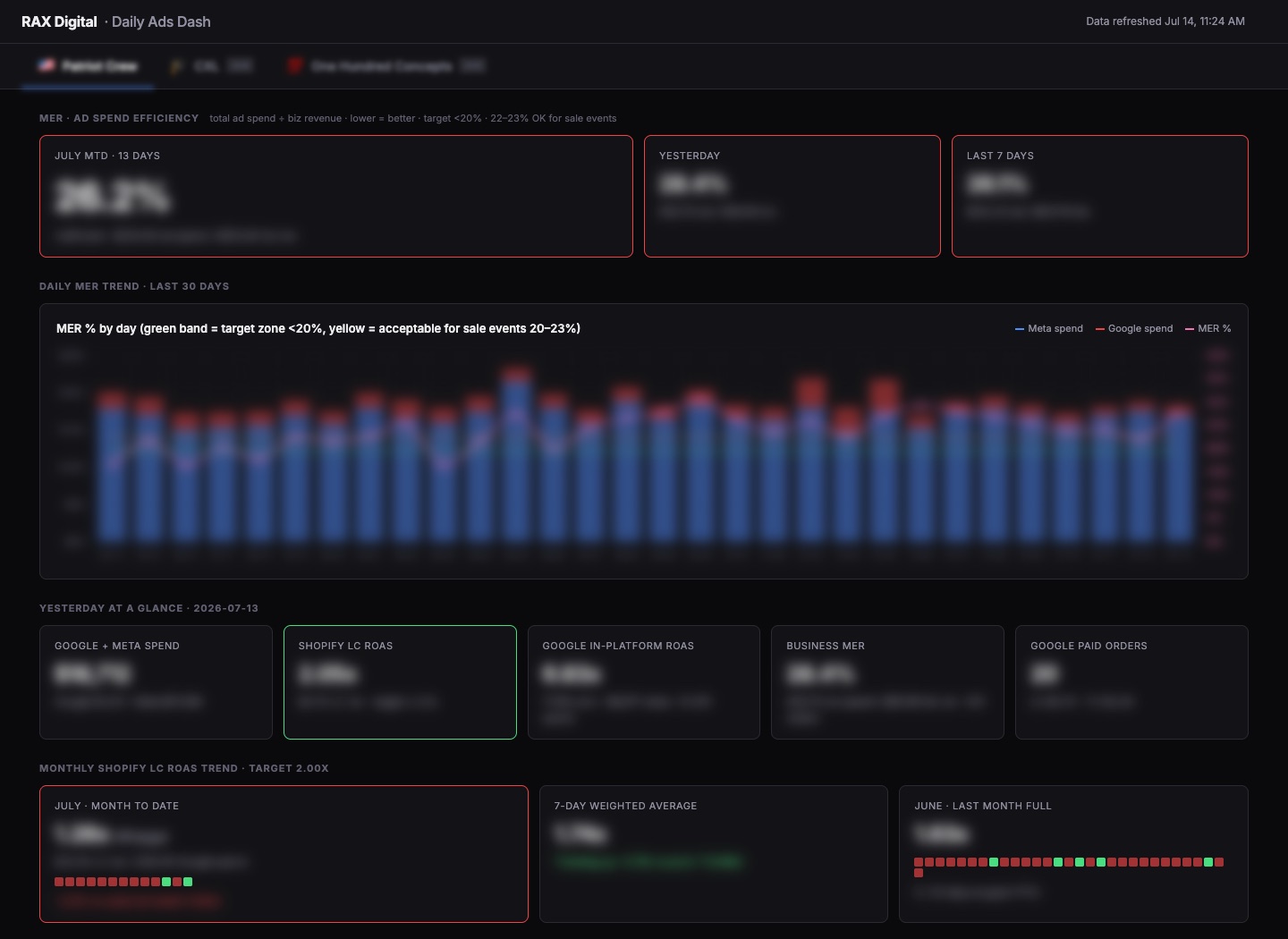
It is not trying to be GA4. It is not trying to be Triple Whale. It is not trying to be a full business intelligence platform with 19 menus, cohort explorer, attribution modeling, custom segments, saved views, onboarding checklist, demo request modal, and a little help widget that follows you around like it pays rent.
It is bare bones on purpose because paid ads do not need to be made more mysterious.
For paid ads, the questions I care about most are pretty simple:
- Are we profitable?
- Is spend efficient?
- Are we pacing too hot or too cold?
- Which channel is creating the problem?
- Which campaign or product needs attention?
- What should happen today?
That is it.
There are a lot of other things I can look at. There are always more things to look at. That is how marketers get lost in the sauce.
The real skill is knowing which few numbers matter enough to change your behavior.
The old software model created more work
A lot of marketing software was built around the idea that the user wants a place to live.
Log in every day. Click around. Learn the interface. Build reports. Save views. Invite the team. Get the weekly digest. Watch the product tour. Upgrade to unlock the thing you thought you already paid for.
Fun little world we made for ourselves.
Three or four years ago, a lot of the things I now do with Claude Code, Codex, a repo, and a few API calls would have been entire SaaS products. You would sign up, connect your accounts, sit through onboarding, learn another UI, get emailed twice a day, and then eventually forget the tool existed until the next invoice hit.
Some of those tools are useful. I am not pretending software is dead.
But AI is changing the shape of the question.
Instead of asking:
Which tool has the best dashboard for this?
I am asking:
What decision am I trying to make, and what is the shortest path to that decision?
That is a much healthier question.
It cuts through a lot of the theater. Especially in marketing, where people love building elaborate reporting systems that make everyone feel productive without actually changing what happens next.
GA4 is the perfect example
GA4 is powerful.
It is also a place where normal human momentum goes to die.
You open it with one question and 12 minutes later you are looking at an exploration report with a dimension you do not trust, a conversion event you forgot was renamed, and a number that somehow disagrees with the number you pulled from the same tool yesterday.
This is the kind of screen I mean. Useful data, buried inside a workflow that still makes you do too much work before you can make a decision.
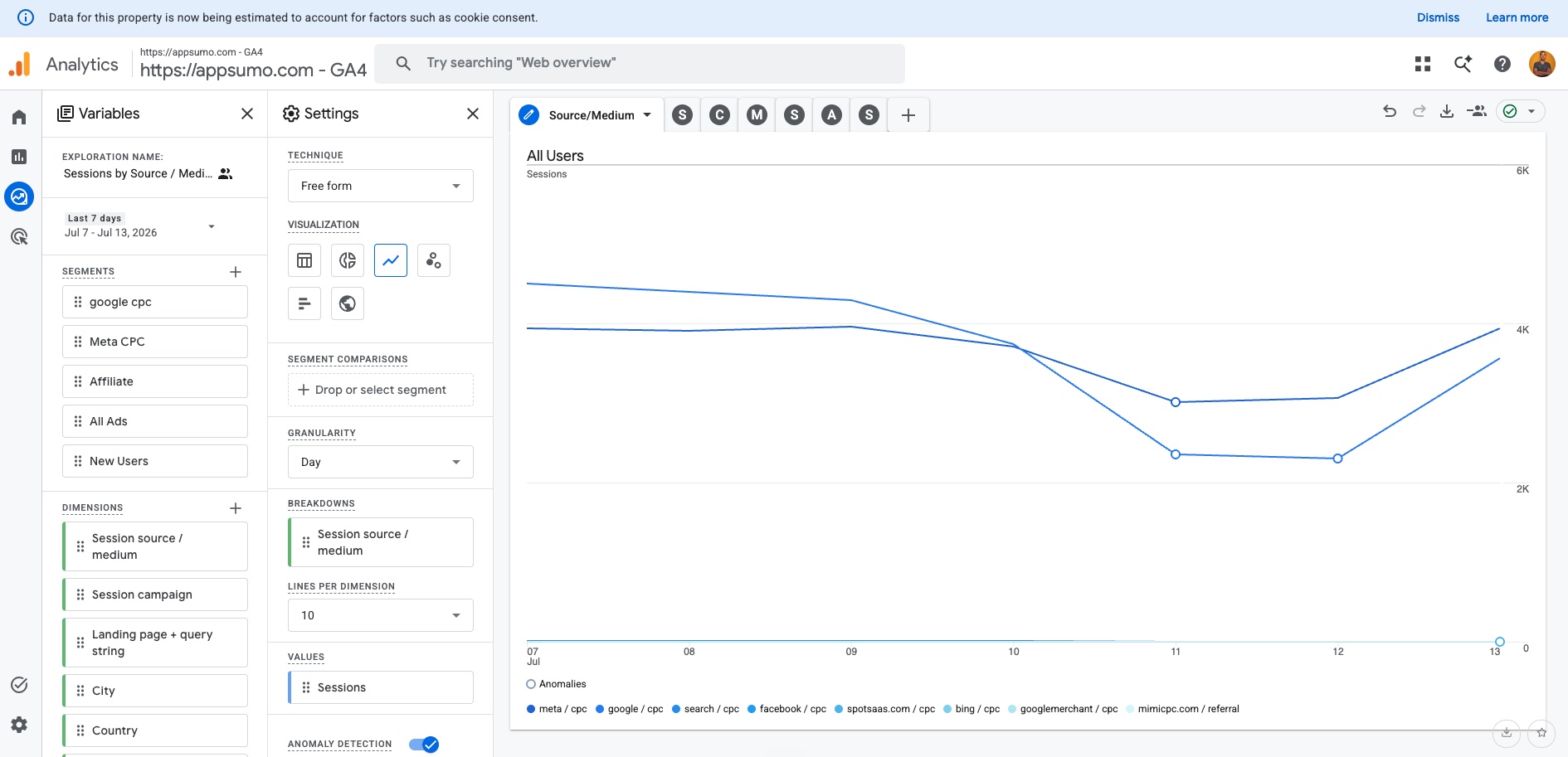
Again, I am not saying do not use GA4. We use it. You need analytics.
But the interface is not the point.
The point is the decision.
If I want to know whether a landing page is converting worse this week, I do not want to build a mini research project every time. I want the system to pull the right data, compare it to the right baseline, tell me if the change is meaningful, and put that answer somewhere I will actually see it.
Same with ad platforms.
I do not want to stare at Meta Ads Manager trying to look busy.
I want to know if the spend is going to the wrong placement, if 16:9 videos are getting enough distribution, if creator ads are carrying the account, if Instagram is eating budget that should be tested on Facebook.com, or if a campaign is quietly burning money because the platform is optimizing toward the wrong thing.
The work is not clicking around. The work is judgment.
AI can create focus or destroy it
This is where AI gets weird.
Used badly, AI creates even more distraction. More reports. More summaries. More Slack updates. More charts. More tasks. More fake productivity. More things that look impressive in a screenshot and make your actual day worse.
Used well, AI creates focus. It pulls the numbers before you ask, does the math you should not be doing manually, compares today against the right baseline, turns meeting notes into action items, tells you what changed, and gets the busy work out of the way so the good marketer can do the marketing.
That last part matters.
I think this is one of the most positive shifts AI can bring to marketing. It can make the best people better because they spend less time proving they are busy and more time getting to the truth.
You do not need to be great at digging around in analytics reports, remembering where GA4 hid the useful thing this week, doing profit-to-spend math in a spreadsheet, or manually building LTV:CAC visuals to be a good marketer.
You need to understand the customer, understand the offer, know what numbers actually matter, have enough taste to know when the work is good, and have enough business sense to know when a metric is lying to you.
AI can help with the rest.
The best dashboard is the one that disappears
The more I build these systems, the less I want a dashboard as the final destination.
Sometimes I want a dashboard, like the RAX one above, because I want one place to see the health of the account. But even then, the dashboard is not the point. It is a staging area for decisions.
The better version is a Monday memo in Slack.
Or a daily ads update that says:
Profitable day. Spend was efficient. One campaign needs attention. Here are the 3 moves I would make.
Or a Granola workflow that pulls action items from the weekly ads call and posts the open loops into Slack before they disappear into meeting-note purgatory.
Or a sheet where the agent stages proposed budget changes and waits for approval instead of making the account exciting in the bad way.
That is the part I care about. Not software for the sake of software. Not dashboards for the sake of dashboards.
Decision support.
This is where marketers should get better
AI is going to make a lot of mediocre marketing activity cheaper.
More mediocre emails. More mediocre ads. More mediocre reports. More dashboards nobody asked for. More "insights" that are really just a paragraph version of a chart.
Cool.
The good marketers should use it differently.
Use it to remove the friction between the question and the answer.
Use it to make the boring math disappear.
Use it to turn dashboards into decisions.
Use it to get closer to the thing you are actually trying to do, which is grow the business.
That is why I like the direction this is going. Not because I want AI to replace the marketer, but because I want it to remove the parts of the job that made good marketers act like dashboard clerks.
Less clicking around. Less reporting theater. Less software pretending to be strategy.
More truth. More focus. More decisions.