My friend Mitchell wrote something this week that stuck in my head: overwatering kills more plants than underwatering.
He was talking about the additive bias. We hit a problem and our instinct is to add something. Add another project. Add another meeting. Add another tool. Add another priority, which is funny because the word priority was singular for about 500 years before we decided to make that messy too.
Paid ads people do the exact same thing.
Performance is down, so we add more ads. CPA is up, so we change budgets. The campaign had a bad day, so we change bidding. Creative feels stale, so we launch five more videos before the last five got enough spend to teach us anything.
It feels productive because you are doing something. The account history looks alive. The Slack update looks good. The client sees movement.
But a lot of the time, you are just overwatering the account.
The algorithm wants a winner
This is especially true now because Google and Meta are not evenly testing every ad like a cute little science fair.
They are bidding systems. They are trying to find the ad, audience, placement, and auction combination most likely to produce the outcome you told them to chase.
When one ad starts winning, the platform will usually concentrate spend there fast.
I pulled a Demand Gen export from an ecommerce account over the last 14 days. Anonymized, obviously. There were 10 video ads in the ad group. One ad drove 55% of all clicks. The top two drove 75%. The top three drove 84%. The top five drove 92%.
That is not a broken test. That is how these systems work.
The machine found the ad it trusted most and pushed the money there. You can fight that, or you can design your testing system around it.
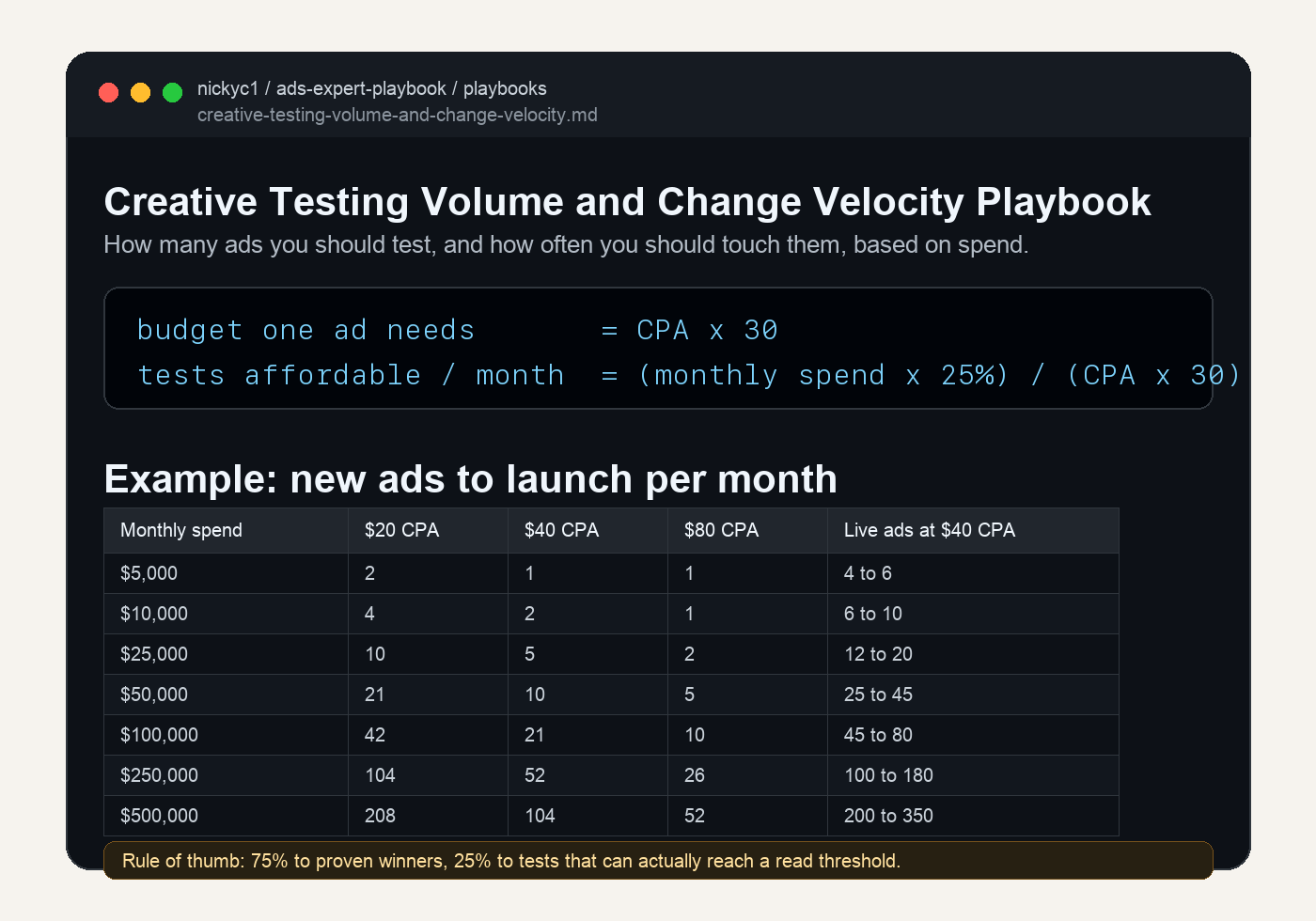
I put the working version of this into GitHub as a creative testing and change velocity playbook. The repo is just where the rule lives so I can reuse it across accounts instead of re-arguing the same thing every time a creative calendar gets out of control.
Creative Testing Volume and Change Velocity Playbook
Testing more can make you learn less
This is the part that feels backwards.
I am pro testing. I have spent over $10 million on paid ads and most of the wins came from testing ideas that looked weird or obvious only after they worked.
But testing is not the same thing as launching more ads.
Testing means giving an idea enough money and time to produce a read you would actually defend.
Last week I pulled 60 days of Meta data from one of our own accounts because Noah asked a simple question: are we testing enough creative?
I expected the answer to be no. That is usually the default answer in paid media. Launch more, learn more.
The data said the opposite. We launched 247 new ads on Meta in one month. The median ad got $29 of spend. 57% never produced a single purchase. Out of 585 ads, only 13 got enough conversions to tell us anything.
Our CPA was in the $40s, so an ad needed roughly $1,200 behind it before I would trust the read. The budget could fund about 10 real tests a month. We were launching about 25 times that.
That is not a testing machine. That is a budget shredder with a creative calendar attached to it.
The funniest part, if you enjoy painful account audits, was the naming. Every ad was named like meta7168, meta7169, meta7170.
So even the winners were hard to learn from.
Did UGC beat founder video? Did the security angle beat the price angle? Did a customer story beat a product demo?
No idea. The report could tell us which number won, not which idea won.
Two months of creative work and the account still could not clearly tell us what the market cared about.
That is the real cost of over-testing. Not just wasted spend. Wasted learning.
The read threshold
The framework I use now is simple.
An ad needs about 30 conversions before I treat the result as directional. 50 conversions is where I start feeling better about making a stronger decision.
So the basic math is:
budget one ad needs = target CPA x 30
If your target CPA is $40, one ad needs about $1,200 before it has earned a real read. If your monthly testing budget is $12,000, you do not have room for 100 new ads. You have room for about 10.
That does not mean you only make 10 pieces of creative. Make the messy backlog. Keep the ideas flowing. Use AI to help organize concepts, pull customer language, write hooks, resize assets, and package the work.
But do not push everything live just because it exists.
The account has a carrying capacity. Ignore it and every test gets thinner.
The same rule applies to changes
Creative is the obvious version, but budget and bid changes have the same problem.
Every time you touch a campaign, you are asking the model to adjust.
Sometimes that is needed. I am not saying leave bad campaigns running forever because the algorithm needs a nap.
But daily tinkering usually creates the volatility you then react to.
On Meta, I generally want budget moves of 20% or less, then give it 72 hours before touching it again unless something is clearly broken.
On Google, I am even more patient with bid targets. tCPA and tROAS moves should usually be 15% or less, then wait two weeks or 30 conversions, whichever comes first.
The more automated the platform gets, the more restraint matters.
You are not managing a spreadsheet. You are training a model with money.
The boring fix
The fix is not exciting, which is usually a good sign.
Cap the number of live ads. Set a spend floor before judging anything. Name every ad by concept so the report tells you what idea won. Keep one proven winner live and give challengers enough budget to earn a real shot. Make fewer material changes, then actually wait long enough to see what happened.
For most accounts, this will feel uncomfortable because it creates less visible activity. There are fewer new things to screenshot. Fewer updates that sound impressive. Fewer chances to look like you are constantly optimizing.
But the account gets cleaner. The budget gets less fragmented. The platform has an easier job. And you learn faster because the tests can actually finish.
That is the real lesson from the plant thing. The answer is not to stop watering. The answer is to stop drowning the thing you are trying to grow.