I have been running ads for almost 15 years, and the most obvious creative shift I am seeing right now is not AI-generated ads.
It is creators advertising on behalf of brands.
Not influencer marketing in the old sense.
Not "send a product, get a post, hope it gets likes."
I mean creators, customers, operators, founders, employees, and niche voices becoming part of the paid media system itself.
Most marketers I talk to are working with creators in some capacity now. Very few are doing it well.
They still treat creators like a channel.
I think that is too small.
Creators are becoming a new creative layer inside paid acquisition.
Google calls it Creator partnerships boost.
Meta calls it partnership ads.
TikTok calls it Spark Ads.
LinkedIn calls it Thought Leader Ads.
Different names. Same idea.
The person your customer already trusts becomes the front door to the ad.
That matters more now because trust in brand voice is eroding.
Audiences are savvier. Younger buyers, operators, developers, founders, and tech-forward people can feel when a claim has been polished to death. They can read the difference between a useful recommendation and a brand-approved pitch.
Then AI made the feed noisier.
Now every feed is getting flooded with AI written posts, fake experts, AI avatars, and videos where everybody has perfect skin and six fingers. I use AI all day and even I am tired of looking at it.
So a real person explaining a product in their own words hits differently.
Not because it is magically authentic.
Because the message is being carried by someone who already has permission with the audience.
People buy from people. That line sounds obvious because it is obvious.
The part most teams miss is operationalizing it.
You are not downloading somebody's video and reposting it from the brand account. The creator gives you permission to put paid distribution behind their original post or video while keeping their identity attached to the ad. On Meta, the partnership ad can show both the creator and brand identities. On YouTube, the ad can run from the creator's channel. On LinkedIn, the original person's post becomes the ad.
Same product. Same offer. Same media budget.
Completely different ad, because the messenger changed.
This post is my complete playbook for that shift: why small creators are working especially well right now, how to find the right people, how to connect the ad platforms, how to structure budget, and how I would use Claude Code or Codex to manage the operating system around it.
Why you should care
This is showing up in the performance data now.
Google reported in March 2026 that Creator partnerships boost on YouTube Shorts produced an average 30% increase in conversion lift for Demand Gen campaigns while maintaining CPA efficiency. That came from global campaign data running from January 2025 through January 2026.
TikTok's November 2025 creator analysis found creator ads drove 70% higher click-through rates and 159% higher engagement than non-creator ads at the same CPM. Ads posted from a creator's account also had 59% higher engagement and a 16% higher six-second view-through rate than ads that were not.
Meta reported after Cyber 5 2025 that mixing creator content into always-on campaigns through partnership ads reduced acquisition costs by 19% and increased brand intent by 71%.
The format matters too. Meta says advertisers adding vertical video with audio to their Reels strategy saw 34.5% lower CPA than image ads.
What it tells me is where attention is moving. Native video is beating the static brand ad, and creator-led versions are beating brand-made video often enough that every serious paid team should be testing them.
All of these numbers come from the platforms selling the ads, so keep your eyebrow slightly raised. Still, Google, Meta, and TikTok are all finding the same pattern across different data sets.
Your customer persona is only half the work
Most marketing teams can describe their customer persona.
Who buys? What do they care about? What are they trying to solve?
You also need to know who that customer trusts.
Jay Acunzo calls this the trust persona.
Who do they listen to before making a decision? Whose recommendation lowers their guard? Who has already earned the right to shape how they think?
Jay's point is that these people already have the trust of your ideal audience. Partnering with them lets you transfer some of that trust instead of trying to manufacture it from zero through another brand ad.
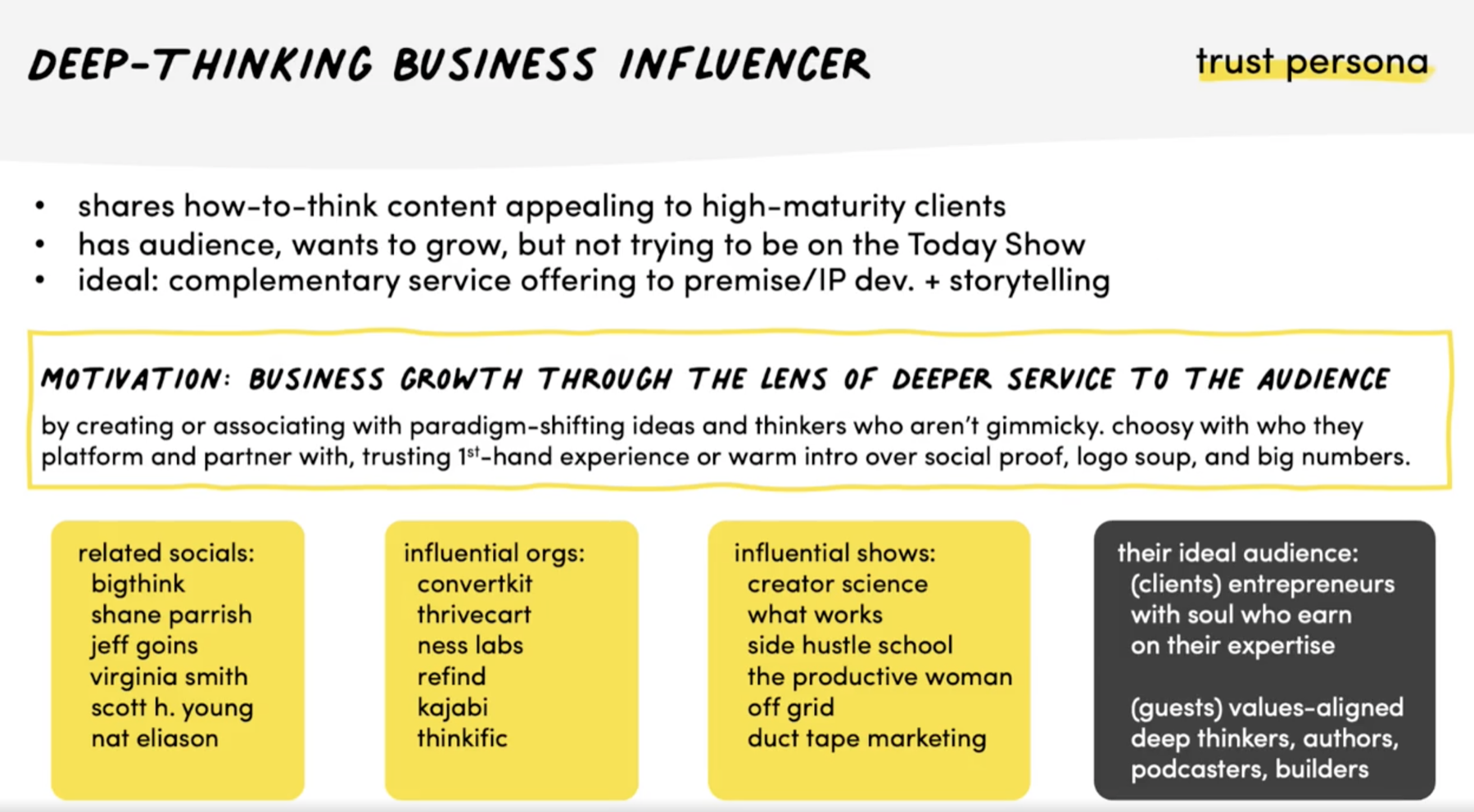
Image credit: Jay Acunzo's LinkedIn post on trust personas
For a new parent it might be a pediatric nurse with 8,000 Instagram followers.
For an ecommerce founder it might be an operator posting honest teardown videos on YouTube.
For a developer it is probably another developer who has built with the product and is willing to show where it breaks.
Follower count is way down my list.
I would rather have a customer with 6,000 followers who actually uses the product than a creator with 600,000 followers and 14 brand deals this month.
Start here:
- Customers who already have an audience
- Customers who make good content even if the audience is small
- Employees, founders, partners, and operators the customer respects
- Outside creators your customer already watches
If someone is not a customer yet, make them one before asking them to tell everybody how amazing the product is. Let them use it. Give them access to the team. See what they honestly think.
The numbers are pretty hard to ignore
I am seeing this in the accounts I am actually touching too.
In one recent AppSumo Meta pull, I looked at a ten-ad batch where the video variants were only 8.5% of spend.
They drove 43.1% of the clicks.
The video ads averaged an 11.18% CTR. The static ads averaged 1.38%.
That does not mean "video always wins." The static ad in that batch still carried most of the purchase volume because it had most of the budget.
But it does show the pattern I care about: when a real person or native-feeling video earns attention, Meta can find clicks fast.
In a separate ecommerce account I manage, I pulled 1,565 Meta ad rows from the last 30 days.
Creator and whitelisting videos were 54.5% of spend, 57.8% of clicks, and 51.3% of reported purchases.
They had a 1.46% CTR versus 1.04% for static ads. That is a 41% lift.
CPC was lower too: $1.04 for creator videos versus $1.14 for static.
At basically half a million dollars a month in Meta spend, small creator partnerships are not a cute brand test.
They were carrying half the account.
And the platform case studies are pointing in the same direction.
Google tested one brand video against two creator videos for a business-setup company. The creator ads averaged 236% higher ROAS and 66% lower CPA.
The smaller creator had 106,000 subscribers compared with another creator's 498,000, but her ad produced a 143% higher conversion rate than the brand ad.
Her audience was smaller. Her voice fit better.
eBay saw creator-made YouTube Shorts ads produce a 57% higher click-through rate than its standard ads.
Suroskie Beauty ran videos from nano creators as Meta partnership ads and generated 1.7 times more website purchases than its usual video ads.
Snowflake promoted LinkedIn posts from people its audience already knew. Two external voices reached a 5.6% CTR, 2.7 times higher than its Single Image Ads. A later post from its principal developer advocate hit a 21.2% CTR and drove 64 sign-ups.
Bristol Myers Squibb used a phone video from a practitioner trusted by other healthcare providers. They deliberately did not choose the person with the biggest following. That ad produced a 287% higher CTR and 297% higher engagement rate than its previous videos.
These are platform case studies so yes, they picked the pretty charts. I would not build a forecast by averaging all of them together.
But the pattern is real. The person and their relationship with the audience matter more than how polished the video looks.
How we set up YouTube creator ads
Google's setup is a little confusing because there are two different connections.
First you link the brand's own YouTube channel to Google Ads. Then you request access to the individual creator videos you want to run.
Do not ask for access to the creator's whole channel. You only need the videos.
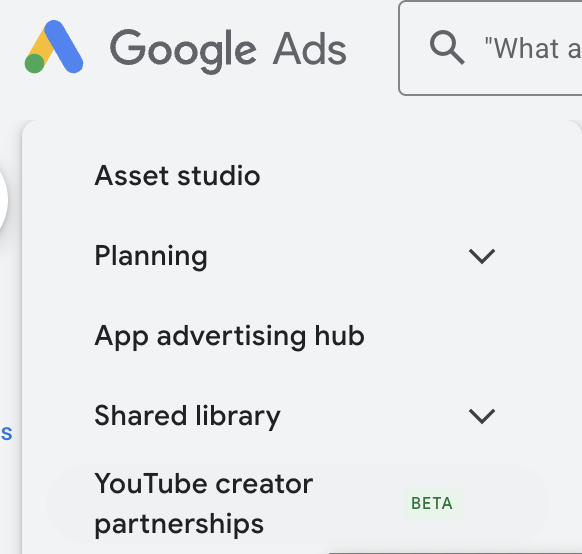
1. Link the brand channel
You need admin access to the Google Ads account.
- Open Tools in Google Ads
- Go to Data Manager
- Select Connect Product and choose YouTube
- Select Add channel or New link
- Search for the brand channel or paste its URL
- Enable the permissions you want and complete the link
We enabled view counts, remarketing, and engagement.
You can also start inside YouTube Studio under Settings, Channel, Advanced settings, Link Account. Add the Google Ads customer ID there, then approve it from the ad account.
2. Get the creator video ready
The creator uploads a normal YouTube video or Short. Public and unlisted videos work. Private videos do not.
We asked for vertical, square, and horizontal cuts as separate unlisted uploads. That kept duplicate versions off the public channel but gave us the formats needed for Shorts, in-feed, and other placements.
The creative brief was simple:
- Say what the product is in the first one to two seconds
- Show it naturally
- Disclose the partnership
- Give people one clear next step
- Talk like yourself
If the creator sounds like someone from legal wrote the script they are probably going to get legal-level engagement.
3. Request access to the video
I prefer the brand-initiated path because you can see exactly where the request is stuck.
- Open Tools, Data Manager, YouTube
- Select New link
- Choose Link video
- Paste the exact YouTube video URL
- Submit the request
It will sit under the Sent tab until the creator accepts.
The creator gets an email from Google Ads. They click Review request, land in YouTube Studio, and approve the link.
If they miss the email, they can open YouTube Studio, go to Content, filter for Brand access: Requested, open the video, and approve it from the Brands section.
Creators can also initiate the connection themselves from the Brand partnerships section in YouTube Studio. Those show under Received in Google Ads.
4. Check the permissions
After approval, the creator video should show:
- Video performance
- Remarketing
- Creator partnership boost
This is the finished setup. The brand channel is linked at the top and approved creator videos sit underneath it.
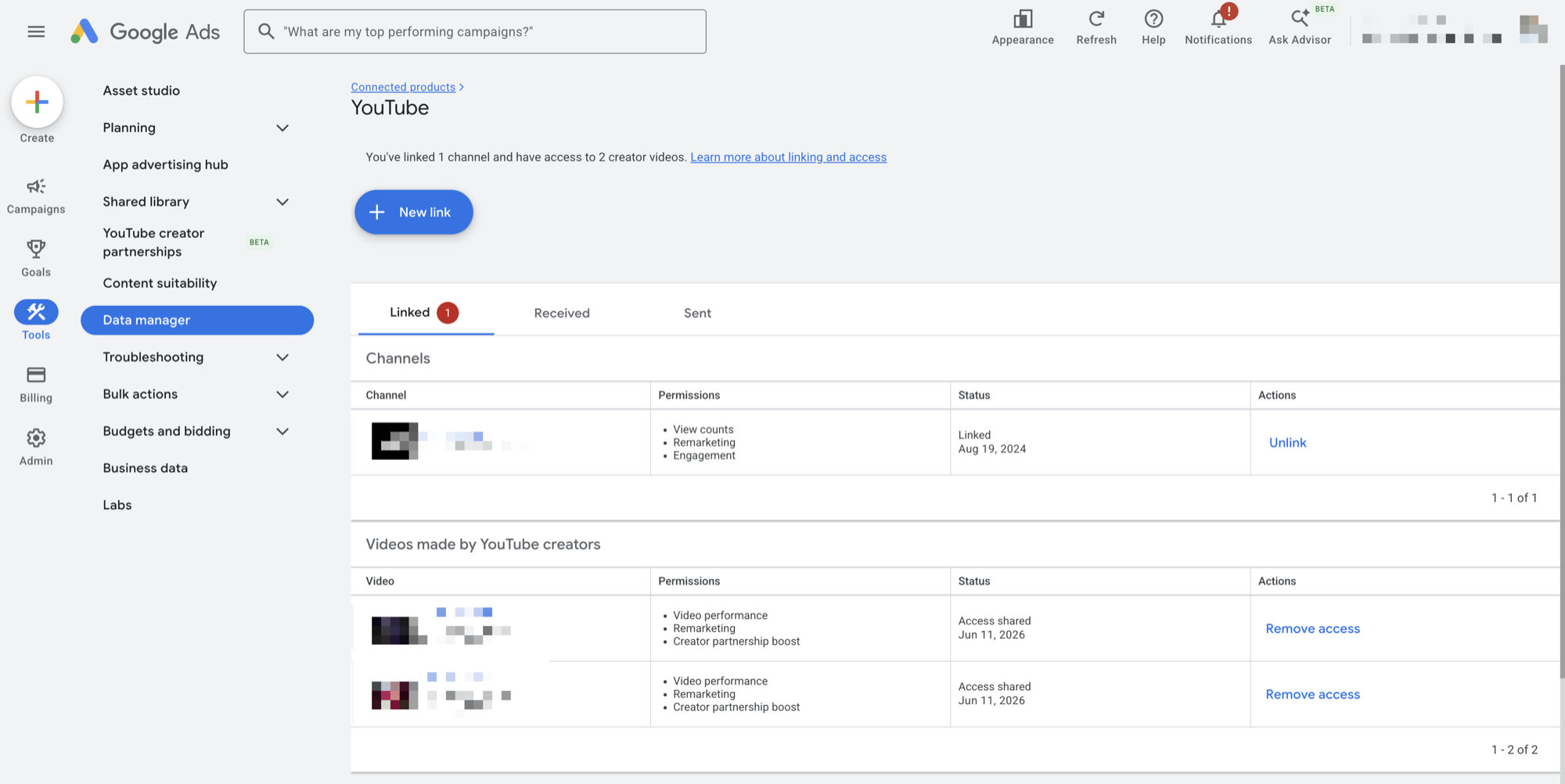
The creator still owns the video. The advertiser cannot edit or delete it, and the creator can remove access later. Put the paid usage term in a separate agreement so everybody knows what was approved and for how long.
Google says the connection can take up to 24 hours to fully sync.
5. Use the video in a campaign
When you get to the video-ad step, search for the creator's exact title or paste the YouTube URL and select the linked video.
Google supports creator videos across Demand Gen, Video Reach, Video View, App, Performance Max, and other supported video campaigns. The exact co-branded layout depends on campaign type.
The important part is the ad runs from the creator's channel. The viewer sees the person they know, not your brand trying to wear the person's face for 30 seconds.
Meta and LinkedIn work the same way
The buttons change by platform but the operating idea stays the same.
On Meta, Instagram Creator Marketplace can help you find creators, manage projects, and turn approved content into partnership ads. A creator can authorize a specific post or give broader advertising permission.
Meta is where I would test the most short-form creator content for ecommerce. The delivery feels native, the conversion system is strong, and you can put creator ads in the same campaign as the rest of your creative so the account tells you what is actually winning.
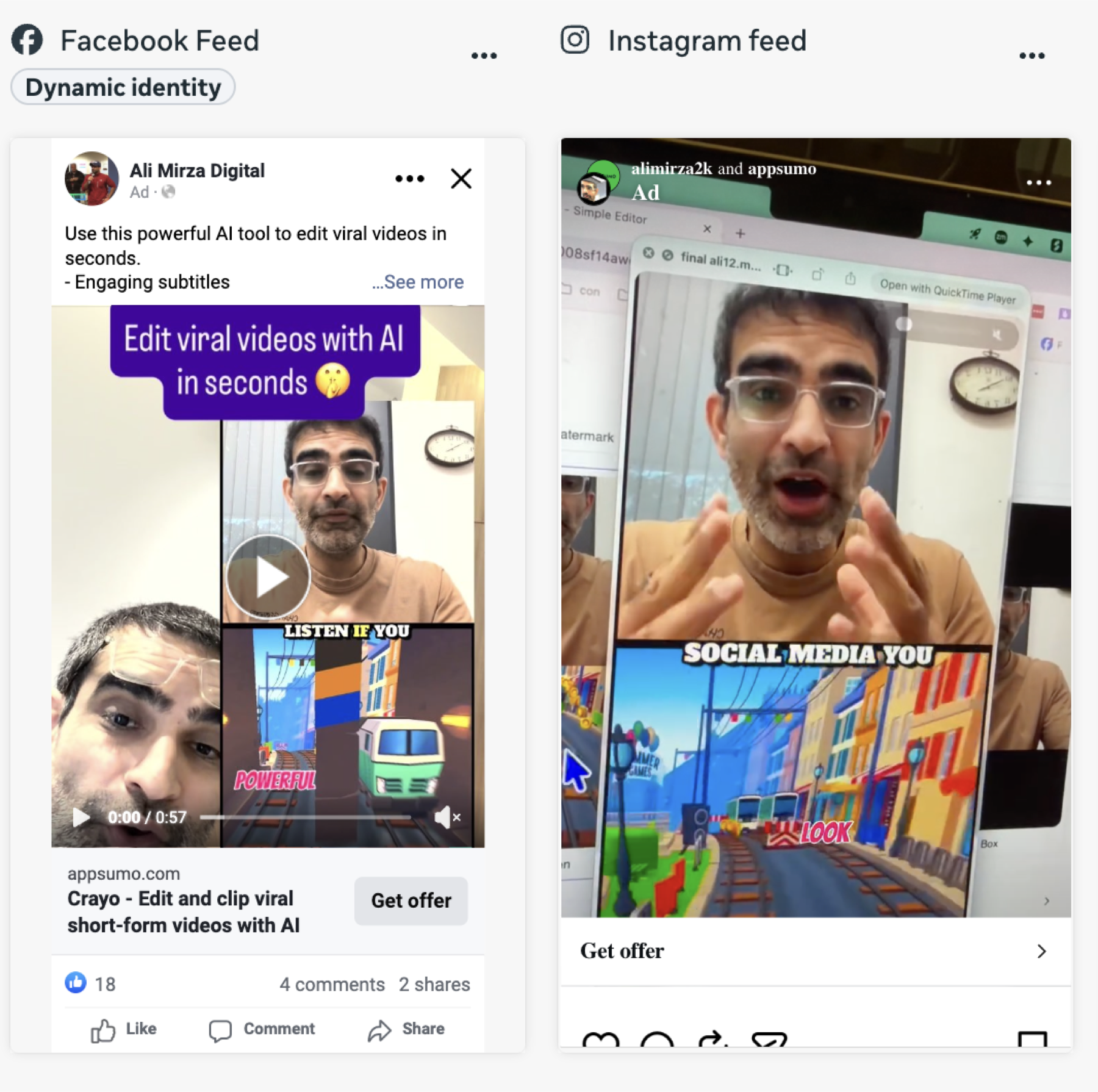
Example from an AppSumo dedicated deal promotion using a creator partnership ad.
Meta says partnership ads let advertisers run ads with partners, including creators, brands, and other businesses. The creator can give access to a specific post, reel, or story, or grant broader account-level permission for eligible branded content.
The practical difference is identity.
The ad can show up with the creator attached instead of looking like another brand-only unit. In the example above, the ad is still selling an AppSumo deal, but the first signal is the person explaining why the product is useful.
We lean on this a lot at AppSumo for dedicated deal promotions. A good creator almost always finds an angle on the product that we would not have written in a normal ad brief.
They might lead with a workflow, a weird use case, a personal pain point, or a before-and-after that only makes sense because they actually understand their audience.
That is the part most brands miss. You are not just renting reach. You are renting interpretation.
LinkedIn Thought Leader Ads are the B2B version.
Use customers, founders, employees, event speakers, partners, and operators with a real opinion. Paying a random influencer to pretend they love your B2B software is a great way to create the world's most expensive employee advocacy post.
LinkedIn lets you find public member posts and request permission to sponsor them. You cannot bolt a shiny new ad headline onto most Thought Leader Ads, which is good. The original post has to be worth reading.
How I would find creators without getting fleeced
The cheapest creator is usually already somewhere in the business.
Search your customer list first. Then employees, affiliates, podcast guests, event speakers, partners, and people already mentioning the product.
After that, use:
- YouTube Creator Partnerships and Creator Search
- Instagram Creator Marketplace
- Partnerships in LinkedIn Campaign Manager
- Normal platform search
For paid discovery I would start with creators around 2,000 to 50,000 followers. That is a rough range, not a law. I care more about who follows them, the consistency of their views, and whether I believe them when they talk.
Collabstr analyzed more than 15,000 collaborations in 2025 and found an average spend of $202 per influencer. Its 2026 report found 80% of collaborations cost less than $300.
For a basic short-form test I would start around $150 to $300 for one finished asset, one revision, and 30 days of paid usage. Specialists, experienced UGC creators, long-form YouTube, raw footage, and longer rights will cost more.
Get this in writing:
- Paid usage term
- Ad accounts and platforms covered
- Organic usage
- Raw footage
- Revisions
- Exclusivity
- Disclosure requirements
- What happens if access is removed
A $150 video you cannot run as an ad is not a deal.
This is where Claude Code and Codex get useful
We have enough fake people selling things already. The useful AI job is running the messy system around the real people.
Give it customer interviews, reviews, sales calls, support tickets, and your most profitable customer segments. Ask it to build the trust persona from what real customers are saying.
Then have it:
- Search the customer list and creator platforms
- Review each person's last 10 to 20 posts
- Calculate median views instead of getting distracted by one viral hit
- Score audience fit, content quality, view consistency, ad potential, cost, and rights
- Draft outreach based on something the person actually posted
- Track replies, pricing, product delivery, content due dates, permissions, and usage windows
- Compare each creator's organic result with their own normal performance
- Compare the paid version against your normal brand ads
That turns a process one person could barely run across 10 creators into something an agency can manage across 100.
The agent should surface the decisions. Your team still decides whether this person feels right for the brand.
Taste matters here. AI can tell you a creator has a 4.8% engagement rate. It cannot fully tell you whether the person has earned trust or has just learned how to manufacture engagement.
My starting budget
I would put 30% of the working media budget toward creator and partnership ads:
- 70% stays on proven ads
- 20% goes to creator ads that already passed testing
- 10% goes to new people, hooks, and formats
Inside the creator program:
- 10% for creator fees and product
- 20% for initial paid testing
- 60% for scaling winners
- 10% held back for edits, rights extensions, and fast follow-ups
On a $10,000 monthly creator budget, that gives you $1,000 to source a few creators, $2,000 to test them, $6,000 behind the winners, and $1,000 in reserve.
Spend more money learning which content works than making one video look expensive.
The testing thresholds I would use
There is no magic view count.
A B2B video with 4,000 views from the exact right people can be worth more than a comedy Reel with 400,000.
For organic content, move it into paid testing when it reaches one of these:
- 1.5 times the creator's median views across 10 comparable posts
- Top 25% of recent posts by engagement
- Strong comments from people who look like customers
- Saves, shares, profile visits, or qualified replies above the normal baseline
For paid tests, I would start here:
| Platform | Minimum test | What earns more budget | |---|---|---| | Meta | 5,000 impressions or 1x target CPA in spend | CTR or CPA beats the account baseline, or two to three conversions land near target | | Google/YouTube | 10,000 impressions or 1,000 paid views | View rate, engaged-view rate, and CPA beat the other campaign creative | | LinkedIn | 5,000 impressions or 50 clicks | CTR or engagement is at least 25% above normal sponsored content |
For a conversion campaign I usually stop after spending 1.5 to 2 times the target CPA without a conversion unless the leading signals are unusually strong.
A winner should produce at least three conversions around the target CPA or beat normal creative by 25% on the primary metric with enough volume to believe it.
Then scale 20% to 30% at a time and make more versions with the same person.
One creator who works should turn into five ads:
- New hook
- New opening shot
- Short cut
- Longer explanation
- Different objection or use case
You already found the hard part. The person.
The weekly operating system
This is the workflow I would give the agent.
Monday: find 50 possible creators and return the top 10 with links, audience fit, normal performance, estimated cost, and the exact reason each belongs.
Tuesday: draft personalized outreach and track replies and terms.
Wednesday: build a one-page brief from real customer language. Give the creator the problem, product facts, proof, offer, and three hook directions. Do not write every word for them.
Friday: compare organic performance with each creator's own baseline and move the qualified assets into paid testing.
Daily after launch: pull spend, impressions, views, CTR, CPA, conversions, comments, and frequency. Recommend hold, stop, revise, or scale.
That is a useful AI job. It handles the volume and remembers who still owes raw footage. The marketer keeps the part that requires taste, judgment, and an understanding of actual people.
We linked two creator videos this week. That is a small setup step, but it points toward where advertising is going.
AI is going to make the machinery faster. It is also going to make every feed more synthetic.
The person your customer already trusts becomes more valuable in both directions.
People buy from people. Build the system around that.
Sources:
- Google: About YouTube Creator Partnerships
- Google: Link YouTube channels or creator videos to Google Ads
- YouTube: Sharing Brand Partner Access to a video
- Google: Creator partnerships boost
- Google: March 2026 Demand Gen creator benchmark
- Google: Using Creator Search
- Google: Creator ads versus brand ads experiment
- Google: eBay creator-made Shorts ads
- Google: Creator-led Pixel campaign
- Meta: About partnership ads
- Meta: Instagram Creator Marketplace
- Meta: Cyber 5 2025 creator results
- Meta: Creator marketing and vertical video performance
- Meta: Suroskie Beauty nano-creator case study
- TikTok: The Creator Advantage
- TikTok: How Spark Ads work
- Jay Acunzo: Trust personas
- LinkedIn: Thought Leader Ads
- LinkedIn: Partnerships in Campaign Manager
- LinkedIn: Snowflake customer story
- LinkedIn: Bristol Myers Squibb COBENFY customer story
- Collabstr 2025 Influencer Marketing Report
- Collabstr 2026 Influencer Marketing Report