Pieter Levels posted something last week that has been stuck in my head.
He said he had already seen Wispr Flow, Granola, and WHOOP reverse engineered and open sourced with free versions.
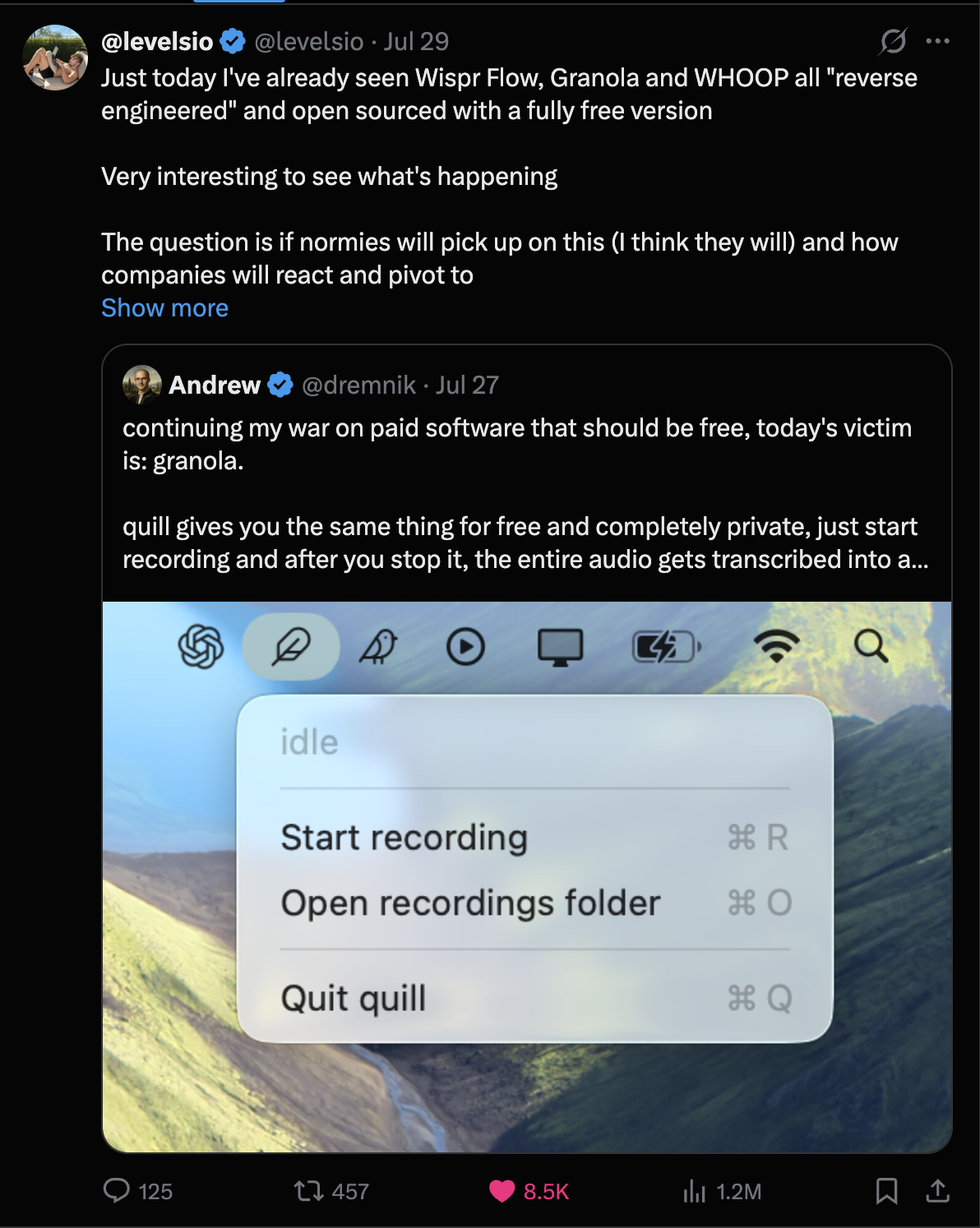
The quoted tweet called it a "war on paid software that should be free."
That sounds a little dramatic, but I get the point.
There is a real reset happening right now around what software is actually worth paying for. Not because software stopped mattering. Software obviously matters. I just built CalConnect and I use paid tools all day.
The thing changing is tolerance.
People are starting to look at a $50, $100, $300/month subscription and ask a much sharper question:
What is this doing that my agent, a repo, a script, or an API call cannot do?
That question is going to make a lot of software uncomfortable.
Thin software is in trouble
I wrote earlier this year that agents are killing software after I realized I did not need a social media scheduler for one of my accounts anymore.
The scheduler was not bad. It did what it promised. But once the agent could talk directly to the Instagram Graph API, the paid UI became less important.
That was the first version of the thought.
This newer version feels bigger.
That one scheduler was the tiny version. The bigger version is a whole layer of software that existed because normal people could not easily connect APIs, process files, summarize information, store context, or automate small workflows without a productized interface around it.
That interface used to be the business.
Now the interface is negotiable.
If a tool is mostly:
- a form that sends data somewhere
- a dashboard that reads from a database
- a meeting summary wrapped in a nice app
- a report builder on top of the same ad data
- a basic workflow with a login screen and billing page
- a thin AI wrapper around someone else's model
Then yeah, the ground is moving under it.
Not because every customer is going to open Cursor and build their own replacement. Most people will not.
But enough operators will. Enough agencies will. Enough internal teams will. Enough open source versions will pop up. Enough AI-native builders will turn the same workflow into a tiny custom tool in a weekend.
That changes pricing power.
Performance marketing has been paying this tax forever
Paid media is full of this.
I have paid for more dashboards, reporting tools, creative trackers, attribution layers, feed tools, spreadsheet add-ons, call summary tools, and "growth intelligence" products than I care to admit.
Some were worth it.
A lot were just a nicer way to avoid doing the thinking.
The older performance marketing stack trained us to believe the answer was always another login. Another dashboard. Another attribution view. Another weekly report. Another AI insights tab that tells you spend went up and conversion rate went down. Riveting stuff.
What I actually need most days is much simpler.
Did we make money?
Where is spend leaking?
Which campaigns are carrying the account?
What changed since last week?
What should we do next?
That is why I keep building smaller internal systems instead of buying bigger external dashboards.
For one ads workflow, the system pulls results every day, compares performance against the rules of the business, and suggests changes in a review sheet instead of making edits directly in the account.
For another, Granola captures the weekly ads call, then a routine pulls action items and posts them into Slack so the meeting turns into work instead of another doc nobody reads.
For the Monday memo, the agent pulls the last seven days of performance and turns it into a decision packet: wins, opportunities, this week's moves, and open action items.
None of that needs to be a giant SaaS product.
It needs clean inputs, good rules, safe permissions, and a place for the decision to land.
The bar for paid software is getting higher
This does not mean I am cancelling every subscription and moving into a cabin with a local LLM and a dream.
I still pay for tools.
I use Granola because it is good. I use Wispr Flow because dictation is now a real input layer for how I work. I use 1Password because credential management is not where I want to cosplay as a hero. I use GitHub, Vercel, Supabase, Stripe, CleanShot, Paste, and plenty of other paid things because they save time, reduce risk, or give me a surface I do not want to rebuild.
The bar is just higher now.
Paid software has to earn the subscription in a way that is harder to fake.
The tools that survive will usually have at least one of these:
- proprietary data
- deep workflow trust
- network effects
- distribution people already rely on
- compliance, security, or reliability that would be dumb to rebuild casually
- taste and polish that actually changes the outcome
- a workflow so annoying that the hosted version is still worth paying for
That last one matters.
Convenience is still a moat. Normal people do not want to maintain scripts, keep API tokens fresh, debug webhooks, or figure out why a cron job silently died over the weekend.
But convenience is no longer enough if the product is expensive and shallow.
This is why the AppSumo lens is interesting
I think about this a lot because of AppSumo.
AppSumo has always sold software to entrepreneurs who want leverage without enterprise pricing. That market is not going away.
But the psychology is changing.
Five years ago, a founder might buy a tool because it gave them a dashboard they could not build.
Now that same founder is asking if Codex can build a good enough version, if there is an open source version, if n8n can handle the workflow, or if the tool is mostly charging them for a UI around something they already have access to.
That makes discovery and trust more important, not less.
If a product is genuinely useful, solves a painful workflow, and lets someone avoid maintaining their own fragile setup, people will still pay.
If it is a thin wrapper with a pricing page, the patience is going away.
This is also why I think performance marketers need to pay attention. The same thing happening to software tools is happening to marketing workflows.
Clients do not want another report.
They want the account to get better.
Founders do not want another dashboard.
They want to know what is true and what to do.
Agencies do not need more software theater.
They need sharper judgment, better systems, and fewer things pretending to be strategy.
The uncomfortable part
The uncomfortable part is that a lot of us have used software as a substitute for thinking.
I have done it too.
Buy the tool, connect the account, build the dashboard, invite the team, feel productive.
Then nothing actually changes because the hard part was never logging into the tool. The hard part was knowing which decision mattered.
AI is stripping some of that away.
It can pull the data. It can summarize the call. It can compare the numbers. It can update the sheet. It can build the small internal tool. It can write the first version of the script that replaces the monthly subscription you were annoyed by anyway.
That forces the actual question:
Do we need this software, or do we need the outcome it was supposed to create?
That is the part I like.
Less software for the sake of software.
More systems that get to the root of the work.
The war is not really on software. The war is on expensive software that forgot what job it was hired to do.