I've been looking at a live account that spent about $51,700 on YouTube ads across August and September. Google reports a little over $177,000 in attributed conversion value from the Demand Gen campaign delivering those ads. Customers are also telling us, after buying, that YouTube is where they first heard about the brand.
And the last two days have been rough. I'm including that part because a breakdown that only shows the good month isn't especially useful if you're trying to run this yourself.
I still think YouTube is one of the most underrated places to advertise right now. Real people demonstrating a product, enough room to explain why someone should care, and a way to reach people before they're searching for you. There's a lot to like. You also have to measure it with something more useful than “did they click and buy immediately?”
This is an anonymized look at an ecommerce account. The numbers are real. I'm leaving out the brand, creators, and identifying campaign details.
The spend and the results
I pulled these numbers on September 30. August is the full month; September runs through the 29th. These are US dollars.
- August: $20,914 in Demand Gen spend, $77,225 in Google-attributed conversion value, and 3.69x reported ROAS.
- September 1–29: $30,788 in Demand Gen spend, $100,472 in Google-attributed conversion value, and 3.26x reported ROAS.
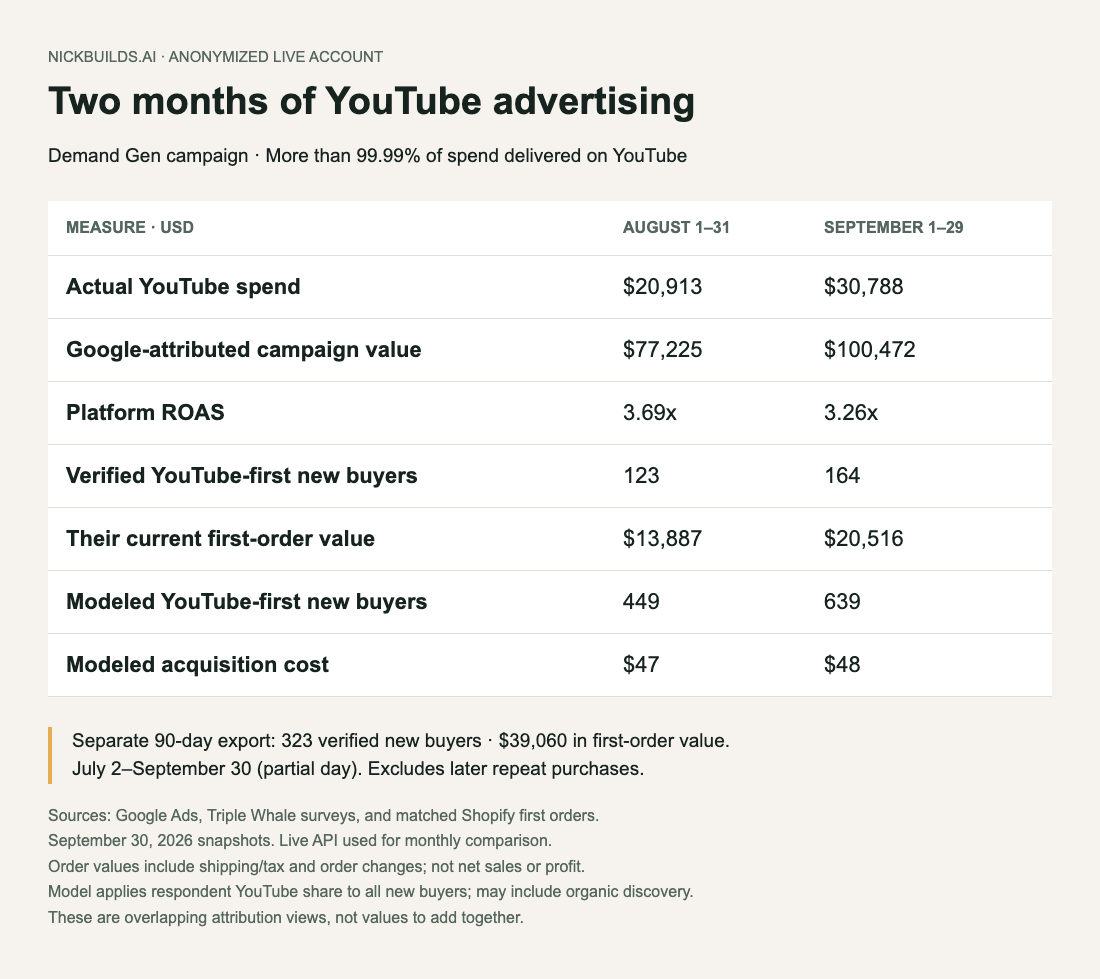
The account spent more across Google overall: $52,325 in August and $62,168 in September through the 29th. I'm separating that out because calling all Google spend “YouTube spend” would give you the wrong picture.
For this Demand Gen campaign, the network breakdown shows $51,700.42 delivered on YouTube out of $51,702.06 total spend across the two periods. That's why I'm comfortable treating this as a YouTube breakdown. Check your own delivery before assuming the same thing.
September's spend increased while reported efficiency came down. And Google's conversion value is attribution, not profit or proof of incremental revenue. I use it to understand the campaign, then check what happened in the store and what buyers tell us.
What we actually launched
The foundation was creator-led apparel videos and a clear product offer. The more recent expansion added seasonal long-sleeve and hoodie creative alongside the core T-shirt work.
The useful videos show something a buyer wants to know. How does this fit on an actual person? What does the fabric look like? When would I wear it? One creator talks through sizing and how the shirt holds up after washing. Another clip uses close-ups and on-screen copy without spoken dialogue. Both can help someone understand what they're buying.
I care about whether the person is believable and whether the video gives them something specific to say or show. An enthusiastic person reading generic praise doesn't do much for me.
The campaign build follows the product. T-shirt creative goes with T-shirt products. Seasonal creative gets its own product grouping and a relevant destination. The product feed filters, headlines, descriptions, and landing page should agree with the video. If someone just watched a hoodie demonstration, making them hunt through unrelated products adds a completely avoidable problem.
We also prepared square and landscape versions of the supplied videos. In the latest batch, that meant keeping the full original frame over a blurred background rather than chopping off the creator or product to fill a new shape. That's a practical way to get format coverage; it doesn't magically turn a weak clip into a good ad.
I wrote earlier about my champion–challenger approach to ad testing. I still want the existing winner to have room to work while new ideas earn their budget. A new batch of assets is a set of tests, even when I like the videos.
The creator is a big part of the ad
Google's YouTube Creator Partnerships area is interesting to me for exactly this reason. You can discover creators, manage relationships, and work with linked creator videos. The screen in my account still labels it beta. Google's documentation explains the available features here.
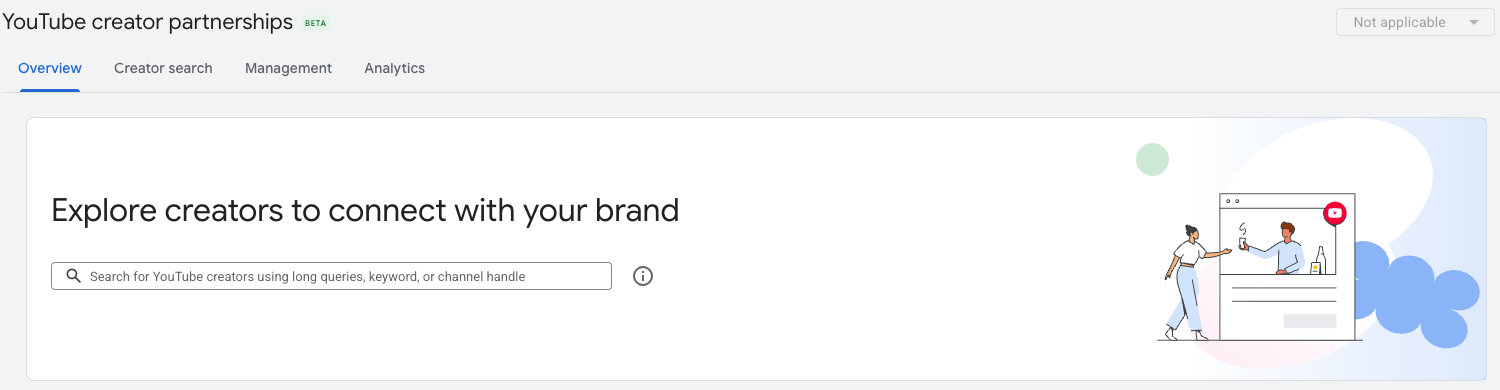
My Creator Partnerships screen, cropped to remove account and suggested-creator details. This is a view of the feature, not evidence that the campaign used creators recommended by it.
A real creator can bring context and familiarity that a brand account has to build from scratch. If you already watch someone, seeing them use a product can land differently from a polished ad featuring someone you've never seen before.
That's my working explanation for why this kind of creative can perform well. This account's results don't isolate the effect of creator trust, and a creator appearing in a video doesn't automatically mean it ran as a linked partnership ad. Those are separate things. But choosing the right person and giving them a useful product story is where I spend my attention.
Ask the customer where it started
Someone sees a YouTube ad, keeps watching their video, and comes back later. They might search the brand, click another ad, open an email, or type in the URL. Expecting YouTube to own both the first encounter and the final click will miss some of what happened.
I want clicks when people are ready. I just don't want immediate clicks to be the only thing the campaign gets credit for. Google also supports engaged-view conversions, which can attribute a later conversion after someone watches an ad without clicking. Even the platform's measurement goes beyond the click.
You've probably heard some version of “it takes seven touchpoints.” I think that's useful as a reminder that people need repeated exposure. Seven isn't a universal number, and plenty of people take a shorter or longer path. The practical question is whether you're measuring where someone discovered you as well as where they finally bought.
The post-purchase question I care about is simple: Where did you FIRST hear about us?
These are people who just bought something. Their answers come with an order ID and an email, so I can connect what they said to an actual purchase. As a business owner, I want to know when a paying customer says, “YouTube is where I first heard about you.” That deserves a lot of weight.
I checked the 90-day Triple Whale survey export against Shopify. All 323 people who answered YouTube matched unique first-time customers, with matching emails. Their first orders currently total $39,060.08. That is observed first-order value from people who named YouTube. It excludes anything they bought again later.
That export covers July 2 through part of September 30. It's a different window from the two months of ad spend above, so I wouldn't divide one by the other and call it ROAS. The value is Shopify's current order total, including shipping and tax and reflecting order changes; it isn't merchandise net sales or profit.
The attribution views I actually use
For a fair monthly comparison, I also pulled the live survey data from Triple Whale and matched it to Shopify first orders by purchase date in Central time. Here's how that lines up with the campaign:
- August: $20,913 actually spent on YouTube. Google reports $77,225 in campaign-attributed value and 3.69x ROAS. Separately, 123 verified new buyers named YouTube, with $13,887 in current first-order value. Adjusting for survey coverage gives about 449 modeled YouTube-first customers at $47 CAC.
- September 1–29: $30,788 actually spent on YouTube. Google reports $100,472 in campaign-attributed value and 3.26x ROAS. Separately, 164 verified new buyers named YouTube, with $20,516 in current first-order value. Adjusting for survey coverage gives about 639 modeled YouTube-first customers at $48 CAC.
Google's attributed value can include existing buyers and gives credit under Google's attribution rules. The survey revenue above counts only the first orders of verified new buyers who actually answered YouTube. They measure different things, and the same purchase can appear in both. I don't add them together.
The monthly figures use the live API snapshot. It had three more YouTube responses than the export across the wider window, including one more September buyer. That's why the export total and the live monthly breakdown don't reconcile by simply adding rows. I kept each snapshot separate.
Here's the model behind the customer estimate. In August, 123 of 3,513 matched first-time-buyer responses named YouTube, or 3.50%. In September, 164 of 3,339 did, or 4.91%. Those surveys covered about 27.4% and 25.7% of all first-time buyers, respectively.
September had 13,016 first-time buyers in Shopify. Multiply that by the 4.91% YouTube share and you get about 639 modeled YouTube-first customers. Divide $30,788 in YouTube spend by that estimate and you get about $48. August uses the same calculation across 12,812 first-time buyers and lands around $47.
The 164 September buyers and their order value are observed. The 639 is modeled, assuming people who answered represent those who didn't. “YouTube” can also include organic discovery, so this isn't an isolated measurement of paid ads. I still find it useful. Platform ROAS fell while the modeled cost of acquiring a YouTube-first customer stayed roughly level.
Shopify confirms who bought and what the order was worth. The survey records where that person says the relationship started. Google tells me what the campaign delivered and which purchases it credited. Together, those give me a much better basis for a decision than a ROAS column alone. I covered the broader business view in the one number your CEO actually trusts.
What those new buyers could be worth
The 323 buyers in the export average about $121 in current first-order value. Their future purchases would add to that. I haven't measured repeat revenue for this cohort here, so I wouldn't dress up an assumption as their actual LTV.
For a simple scenario, say 30% of those buyers place one more $100 order over the next year. That would add about $9,690 across the cohort, or $30 per acquired customer, taking average total value per customer to roughly $151. Change the repeat rate and that number changes. It's a scenario to test against future orders, not a forecast backed by observed retention.
What I'm optimizing for is acquiring customers at a cost the business can afford. To judge whether a modeled $48 CAC works, I need contribution after product costs, fulfillment, discounts, and returns, plus how long it takes repeat purchases to arrive. Revenue alone doesn't answer that.
My read on these numbers is to keep investing in the proven creative, give new tests a defined budget, and investigate the recent decline before increasing spend again. The customer answers give me a reason to keep taking YouTube seriously. They don't give every new ad permission to spend indefinitely.
Where AI helps, and where I still have to make the call
AI makes the execution much faster. I can work through transcripts, draft copy around the actual video, prepare format variants, build consistent ad groups, match products, and check the account structure. It can also pull the reporting that lets me see what's changing without spending the morning exporting spreadsheets.
The people in these videos are real people. The AI work is in the production and operating process around them. I choose which videos are worth testing, what the offer should be, when to launch, and how much room a test deserves.
I've been talking a lot about how far you can take fully automated ad management. I understand the appeal. I also think the difficult part becomes obvious when performance goes sideways.
On September 28, the daily budget moved from $1,200 to $1,400 and a new seasonal batch went live. During September 21–27, the Demand Gen campaign spent $8,332 at a reported 3.81x ROAS. Across September 28–29, it spent $2,848 and currently shows only 0.63x.
Those last two days are still immature. Conversions can come in later, so I'm not treating that ROAS as settled. But the traffic signals changed too: click-through rate fell from about 0.50% to 0.27%, and cost per click rose from $1.38 to $3.70 across those same windows. That deserves attention now.
A budget change and new creative arriving together also make it harder to say what caused the drop. I want to look at where spend moved, which ads actually delivered, whether products and destinations match, and whether the purchase signal is behaving normally. Then I can decide what to hold, reduce, or replace.
AI can help investigate every one of those questions. It can't make the evidence more mature, and I don't want it confidently explaining a cause the data hasn't established. I'm still responsible for the decision and the money behind it.
What I'd take from this
If you're already making good creator videos, YouTube deserves a serious test. Start with a product and a person who can demonstrate it well. Build the campaign so the video, copy, products, and destination fit together. Protect enough budget for the test to tell you something, and decide in advance what would make you stop.
Put the first-heard question after checkout before you start trying to judge the channel. Watch the answers alongside new-customer volume and campaign performance. Keep the survey estimate separate from platform ROAS so you don't count the same customer twice and call it growth.
The last two days haven't changed my interest in YouTube. They have given me a specific campaign to investigate before I put more money behind it. That's the work I'm doing now.