Last year I paid thousands of dollars to have a calendar-syncing app built. It never launched. I had a problem I wanted solved, a pretty clear idea of what the software should do, and money spent on something nobody could use.
This time I sat down with Codex and rebuilt the entire codebase and database in two weeks. CalConnect is live now. It has paying customers.
I was talking to a friend about this today, and I kept coming back to how different that feels. I’ve spent my career in marketing, figuring out what people want and how to sell it. Being able to build the thing myself opens up a whole other set of possibilities.
A problem I already understood
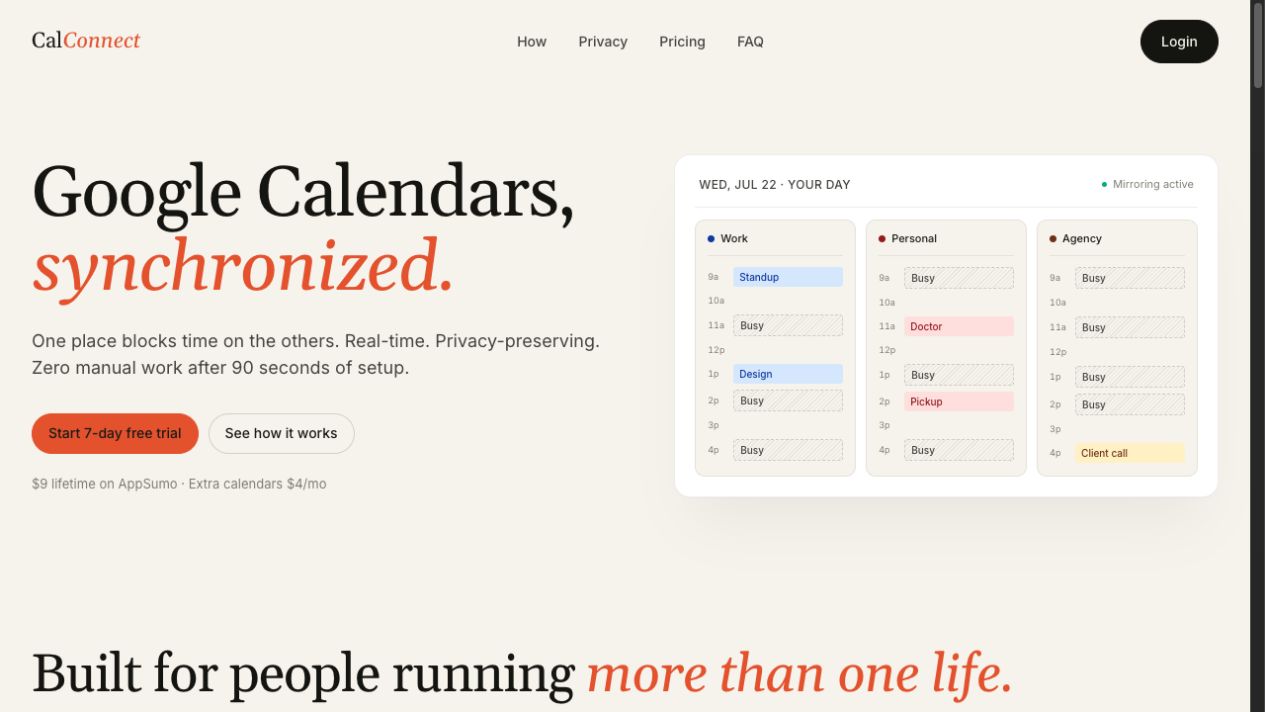
CalConnect keeps Google Calendars in sync. An event on one calendar can show up as a private Busy block on another, so someone looking at your availability doesn’t book over something you already have planned. They don’t need to see the meeting details. They just need to know you’re busy.
That was the thing I wanted. My calendars should agree about when I’m available.
I could explain that problem last year, too. I could describe who would use it and why they’d care. But getting from that explanation to a working product depended on someone else building it. I paid to try to close that gap, and the app still didn’t launch.
A year later, I can work through the build directly with Codex. The two weeks included rebuilding the code and the database. There was still real work to do. Having an AI coding tool didn’t remove the decisions or make me magically understand everything about software. It did let me keep working through the problems until I had something people could actually use and pay for.
Going from an unfinished project to paying customers is a much more interesting result to me than generating an app in a demo. I wanted this thing to exist. Now it does.
Marketers have a useful head start
I think marketers are in a really good position here, especially the ones who spend their days inside the tools and close to the people buying them.
You know the report you rebuild every week. You know which information is spread across three tabs. You know the thing you keep explaining to someone because the software doesn’t make it obvious. You’ve probably paid for a tool that handles most of a job and built a spreadsheet to handle the rest.
There’s a lot of product knowledge in that experience. When you’ve done the work yourself, you can tell whether the first version actually helps. You can notice that the button technically works but puts the result somewhere useless. You can look at a dashboard and know that the one number you need to make a decision is missing.
That’s where I’m getting ideas for tools. ICP Intel comes from wanting a better understanding of the people behind the purchases. CreatorBoard comes from the work of finding creators and keeping those relationships moving. The teleprompter app I wrote about last week came from needing to record a video without memorizing every line.
These are things I want to use. That gives me a starting point and a way to judge what I’m building. It doesn’t prove everyone else wants them, which is where the marketing part gets interesting.
If you’ve spent years selling software, writing landing pages, running ads, or talking to customers, you’ve practiced explaining why something is worth paying attention to. You’ve watched people ignore offers you thought were good. You’ve had to change the message, the audience, or the offer when it didn’t work.
All of that experience comes with you when you start building.
You still have to get someone to care
This is the part of “build and sell” I keep thinking about. A marketer can take a problem they understand, build a first version, and use the skills they already have to get it in front of people. The product work and the selling can happen much closer together.
With CalConnect, the explanation is pretty straightforward: keep your Google Calendars in sync without exposing the details of every event. That’s a specific promise someone can understand before they’ve seen a feature list.
Then the product has to deliver on it. Calendar syncing needs to be reliable. Someone has to connect their calendars and trust what happens next. A good headline won’t make up for an app that gets their availability wrong.
I’m excited about being able to work on both parts. I can change the product when I find something awkward, and I can change how I explain it when the value isn’t clear. I don’t have to turn every small product decision into a separate handoff before I can try it.
There’s also a trap here for someone like me who likes tinkering. Building another feature can feel easier than asking someone to pay. It’s fun, and you get a visible result. But getting the app working only answers part of the question. I still want to know whether someone else cares enough to use it, come back, and pay for it.
CalConnect has reached paying customers. That’s a real step. I’m not pretending two weeks of building answers every question about where it goes from here.
I think we’re going to see a lot more of this
My bet is that we’re going to see a wave of useful tools built by marketers and salespeople who have been sitting with these problems for years. People who know a particular workflow well, know the buyer, and now have a way to build something themselves.
Some of those tools will stay small. Some will be things one person uses every day. Some will turn into businesses. I’m interested in all three, because I’ve already seen how much changes when an idea that was stuck can become working software.
Everybody won’t do this. A lot of people don’t want to spend their time building apps, and that’s fine. But if you do want to, the distance between understanding a problem and doing something about it has gotten a lot shorter.
I’m putting the things I’m building on a new Projects page, with screenshots and a short explanation of each one. CalConnect belongs there because it’s the clearest example I have of that change: last year, thousands spent and nothing launched. This year, two weeks with Codex and paying customers.
If you’re a marketer who wants to try this, start with a problem you can already explain to another person. Build enough to solve it. Then put it in front of someone who has that problem and find out whether they’ll use it.